
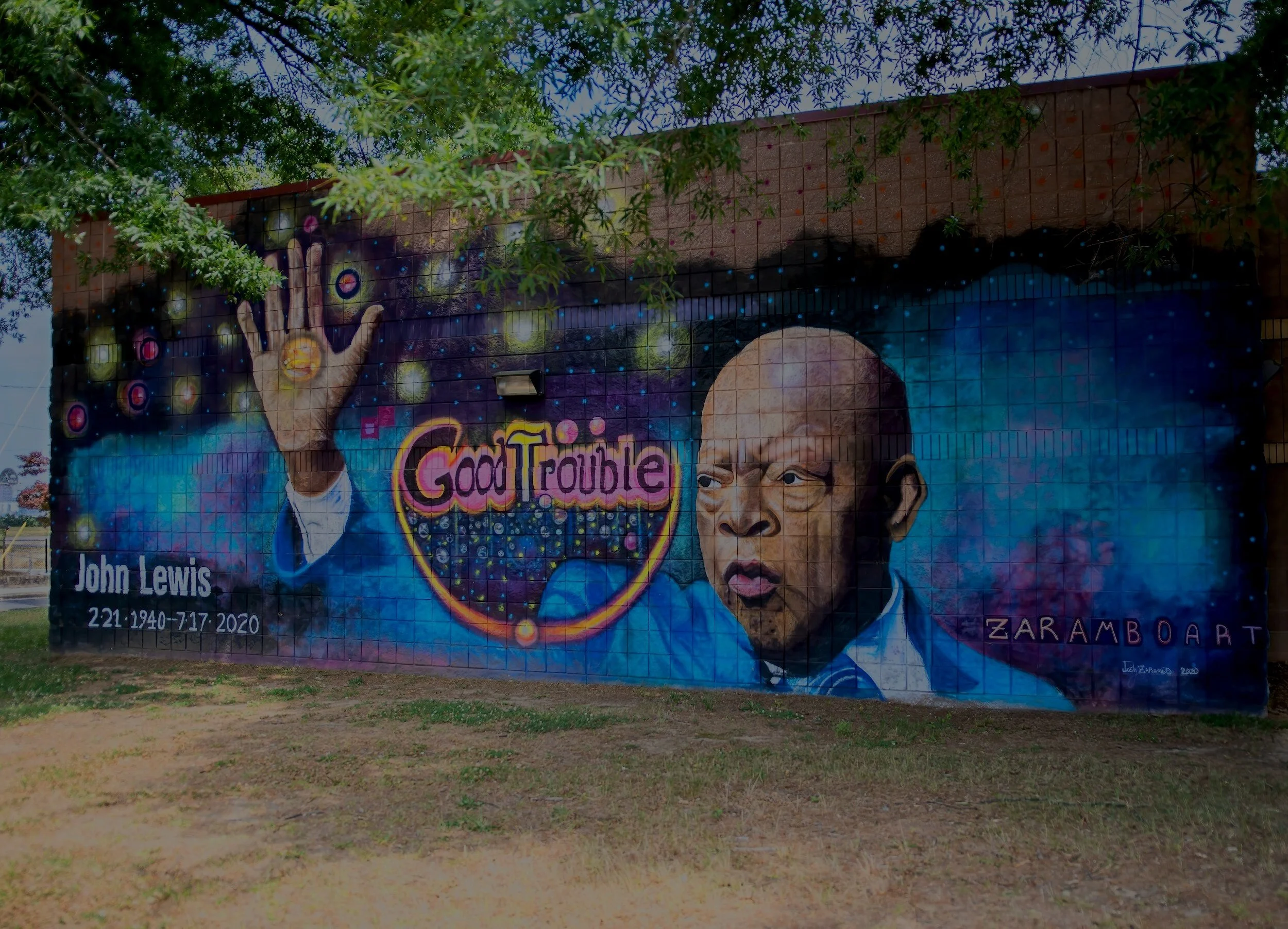
Welcoming Echoes: John Lewis and His Bridge to Truth
Welcoming Echoes-
Some years back, I was standing on the apex of the Edmund Pettus Bridge in Selma, Alabama. As my wife and I continued down the road to the other side, I could vividly imagine the panic in the eyes of those who marched with John Lewis on that “Bloody Sunday,” March 7, 1965. This peaceful group of some 600 people was only looking for fairness. Instead, they found rabid dogs, swinging Billy-clubs, teargas and violence visited upon them. Lewis, only 25 years of age, was resolute in leading with well thought-out passion and courage. What a man of purpose.
As I reflected on that moment, I couldn’t help but consider the many “bridges” John Lewis sought to build and cross -- the many bridges each of us face in life. Some are a pathway to healing, some to opportunity. Some lead us astray, especially if we distrust the compass of truth. The Civil Rights movement had a compass all its own. It pointed towards the direction of dignity, honor and equality. Many in the status quo pushed back on that, obstructing but not stopping the inspirational movement of non-violent demonstrations and civil disobedience.
Welcoming Echoes follows John Lewis from his youthful days to his gradual, “justice-awakening” and full embrace of the “Beloved Community.” We gain a sense of who and what shaped him as a child and why his star shined so bright. This brilliance never dimmed by the many arrests (due to peaceful but “inconvenient” demonstrations) he was subjected to. The words of Lewis, the power of his commitment and the poignancy of painful reversals entwine in a tapestry of a dynamic decade. All this before proceeding to the shadow, then the glory of his later years.
While the 60’s saw boldness in the struggle for Civil rights, it also saw the “Bombings in Birmingham,” the savage reaction to the Freedom Bus riders, dogs loosed on children, the soaring “I have a Dream” speech by MLK, Jr. and critical Civil Rights legislation signed into law. Harm could trip up heroism but never stop it. There was a greatness that called forth followers. Lewis heard this and frequently was its voice. This play gives one a sense of that power, as well as revealing telling moments with the troopers in Selma, John’s agony after RFK’s assassination, growing into becoming a father and his private uncertainties with his career after feeling set adrift by the Rights movement.
If the Black Lives Matter resonated with you, if you were among those who said, “enough is enough,” then you will want to consider the power of this play, the value it extends to each person –no matter their gender, race or creed. We learn through observing both good and bad. Bravery and a strong purpose of mind let those lessons shine. With good fortune and positive intent, maybe today will, indeed, welcome echoes of greatness from the past.
-
Welcoming Echoes reflects the pivotal Civil Rights era in the 1960s, as well as a look back on the tremendously courageous life of John Lewis. This is a man who lived the spirit of a “reach for equal rights and dignity.” From a little boy mesmerized by the sound of Martin Luther King Jr.’s voice and eloquence to an insistent stance as a Freedom Rider and his leadership on the Edmund Pettus Bridge (in Selma), Lewis gives the viewer a true sense of this vital era in our country. Like many of us, this man faced challenge after challenge and refused to stop following his dream. The story is captivating.
-
There is one overall, simple setting for this production (a bridge in the background), although the stage is arranged in three different sections. No scene changes are required.
Ideally, lighting is essential related to letting the characters stand out on different portions of the stage as they have longer parts of dialogue — especially Lewis as both a young and older man.
-
Based on the director’s choice, there can be three women characters (preferred) and two men (men changing roles as Lewis gets older) or, instead, one or two women interchanging the roles.
All characters are Black; age depending on the roles being portrayed. One older man should be in his 40s or 50s, the younger man in his 20s or young 30s.
-
The timing of the play is projected to be around 50 minutes.
-
Special needs — there is PowerPoint (On back screen) with images to enhance the story. There would need to be someone to coordinate careful timing of images.